

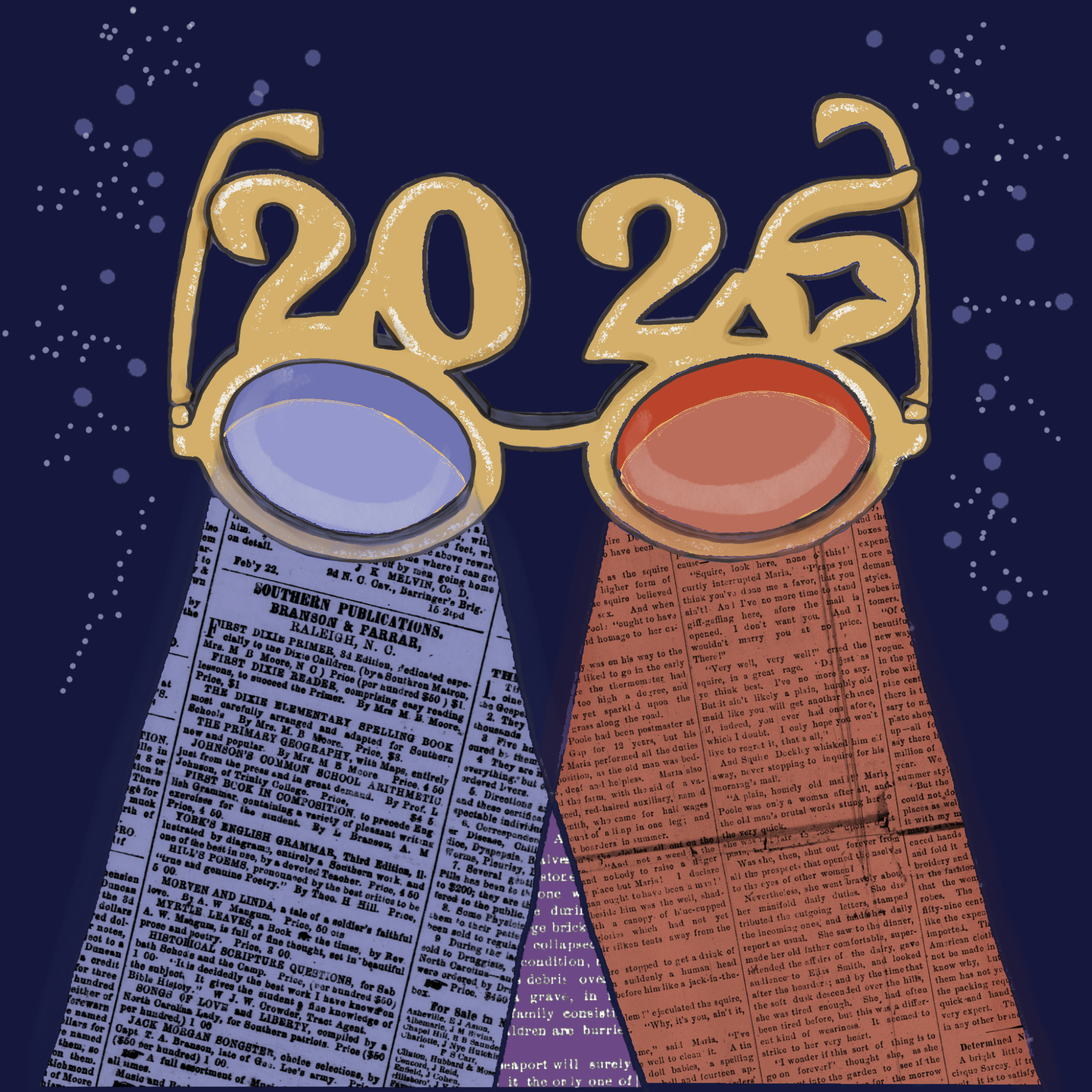
What’s your New Year’s resolution? We are accustomed to traditions of self-improvement to welcome in the New Year, though sticking to new habits and routines is the hard part. Think backwards and ask yourself: Did you fulfill your New Year’s resolutions from last year? If not, now you have another chance. What distinguishes this new year from the last, however, is the exponential growth of generative artificial intelligence (AI) and its encroachment on social media, a major channel for information regarding topics that range from political disputes to favorite celebrities. Social media is such a diverse network of communication and human connection that it would be a waste to let its value be hindered by indistinguishable deepfakes. Misinformed content adapted from AI creates a dangerous game of Telephone played by those who do not do their proper research online. So, a New Year’s resolution that we ask you to consider is this: greater political awareness, especially in the face of AI-generated misinformation.
We live in a time where social media has become an acceptable outlet for information circulation. Granted, the use of this outlet comes with the price of fact-checking, but this is increasingly difficult with the rising popularity and advancement of AI-generated material. Thus it is our moral obligation to maintain awareness of AI-driven misinformation, especially during a time of strained political relationships and authority. News outlets are readily available to us all with a few taps on our phones, so why not reach for an article from The New York Times instead of tuning into a content creator’s 10-part series on TikTok?
However, the issue further develops when we finally recognize that AI poses a threat due to overreliance in addition to misinformation. There is an apparent trend of people with access to media turning towards AI chatbots, like ChatGPT, to ask their pressing questions. Though search engines, like Google, remain primary sources of information, AI’s growing popularity for convenience is becoming harder to ignore. This convenience could threaten journalism if we choose to put all our faith in ChatGPT. Even so, more than 2,000 undisclosed AI-generated news and information websites have been uncovered, according to NewsGuard. Such websites have little to no human supervision, publishing articles or journals completely generated by AI, which creates holes for misinformation to burrow in. Under human regulation, professional fact-checkers and content moderators prevent the spread of misinformation and fabrication.
An audit of the 10 most prominent generative AI tools was conducted by NewsGuard this year, which detected that AI tools fail one in three times. To put this into perspective, the rate has nearly doubled since 2024. Heightened dependence on AI-generated content for information creates a higher demand for increased responsiveness, which consequently has made it more possible for the spread of misinformation. AI feeds on its own content, creating a vicious cycle of propaganda. Ironic, isn’t it?
A 2024 study researching the extent of trust and reliance on AI revealed that consumers tend to overly depend on AI guidance for financially risky decisions and follow advice that goes against their best interests in spite of readily available contextual information online. What kind of future are we hurdling toward if we entrust AI chatbots with our reality? Allowing AI tools to influence our decision-making threatens our personal autonomy when all it can be is a line of code. We, as consumers, are not fully aware of the decision-making process of AI itself, but rather visualize an input and output system, nothing else. Although it is arguable that our own minds are black boxes, as well, the difference is that a human can, at least, verbalize their thought process.
Being an informed individual is crucial to day-to-day decision making and the cultivation of one’s own beliefs. We are unique beings, and it would be unwise to fall victim to AI overreliance and commit to generalized propaganda filtered from a network of real and false information. Be your own individual. Each one of us is capable of conducting our own research from credible, known sources.