

What used to be a groundbreaking concept is now a reality. Artificial Intelligence (AI) development has spiked along with our understanding and use of the technology in our day-to-day lives. 95% of adults have heard about AI in the U.S. Another 73% reported that they would be willing to allow AI to assist them in their day-to-day living. This only goes to show how AI and its increasing usage has become normalized, whether we like it or not. Despite conflicting opinions about this development, AI is here to stay. And it greets you at the entrance of the Peter B. Lewis building on a large flatscreen TV.
For context, in December 2015, OpenAI was founded. The company first released GPT-1 in June 2018, serving as the foundations of what we now know as ChatGPT. Its most recent widespread rendition is GPT-4 with exponential growth and innovative updates. Though GPT software has been around for a decade, the viral usage of AI did not translate to the general public until just a few years ago. In such a short period of time, AI has captured the attentions of many. It is far greater in force than what we’ve anticipated, which is also what makes it so risky.
This year, 88% of organizations have reported utilization of AI within their business. AI integration in the business realm may be one aspect, but schools are trying to find its place in their systems, too. Some are doing so more hastily than others. Case Western Reserve University has Vice-Provost Jeff Capadona on the case to advance productive and ethical usage of AI in educational settings. According to Capadona, new majors are in the works, and the number of AI courses available at CWRU have tripled to over 100 courses across 40 departments. He has expressed that the school has pivoted from a hesitant approach to a swift one in AI adaptation.
CWRU is proud to announce its newest addition to the AI major umbrella, Humanity and Technology (HAT). This isn’t the end, though, as increasing amounts of humanities classes are dissipating at the same time this new era comes to fruition. Arguably, it’s unwise to erase the old with the new, though. The “old” is what provides us with foundation, value and meaning. And recent messaging may be hinting at the fact that CWRU cares more about its image as a tech-savvy institution than it does about the core pillars of education.
To introduce AI into an educational environment at such a high volume comes with high risk. As students, we have seen its takeover in our day-to-day lives. Some of us utilize ChatGPT or other AI resources to study information-dense material, create study guides and learn the step-by-step mechanisms of a complicated math problem. Though these are great examples of how AI can be used effectively in a school environment, the accuracy of AI still remains questionable. Not only this, but overreliance on AI can cause a lack of diversity of thought within classrooms and a loss of the stylistic elements of creative thought. So, to use AI effectively, it is important to understand the material necessary to correct AI’s mistakes.
AI usage also leverages the inevitable possibility that some may use AI to cheat, take shortcuts in homework assignments and generate full-length essays to be turned in the next day to their professors. Many CWRU students have also noticed an increase in their educators using AI-generated content to teach and help grade course material. The use of this tool to formulate such valuable aspects of the education foundation creates the potential for an unstable base to form. Thus technology may come to be relied on more than human intuition and logic. In truth, AI is a slippery slope and there is a fine line between its use and abuse in education. Because of this, CWRU should heavily consider the repercussions of such rapid adoption, especially within the undergraduate context. Here, students are learning the basis of higher education that will continue to support them well into their future careers, and that education must be thorough and without severe shortcuts.
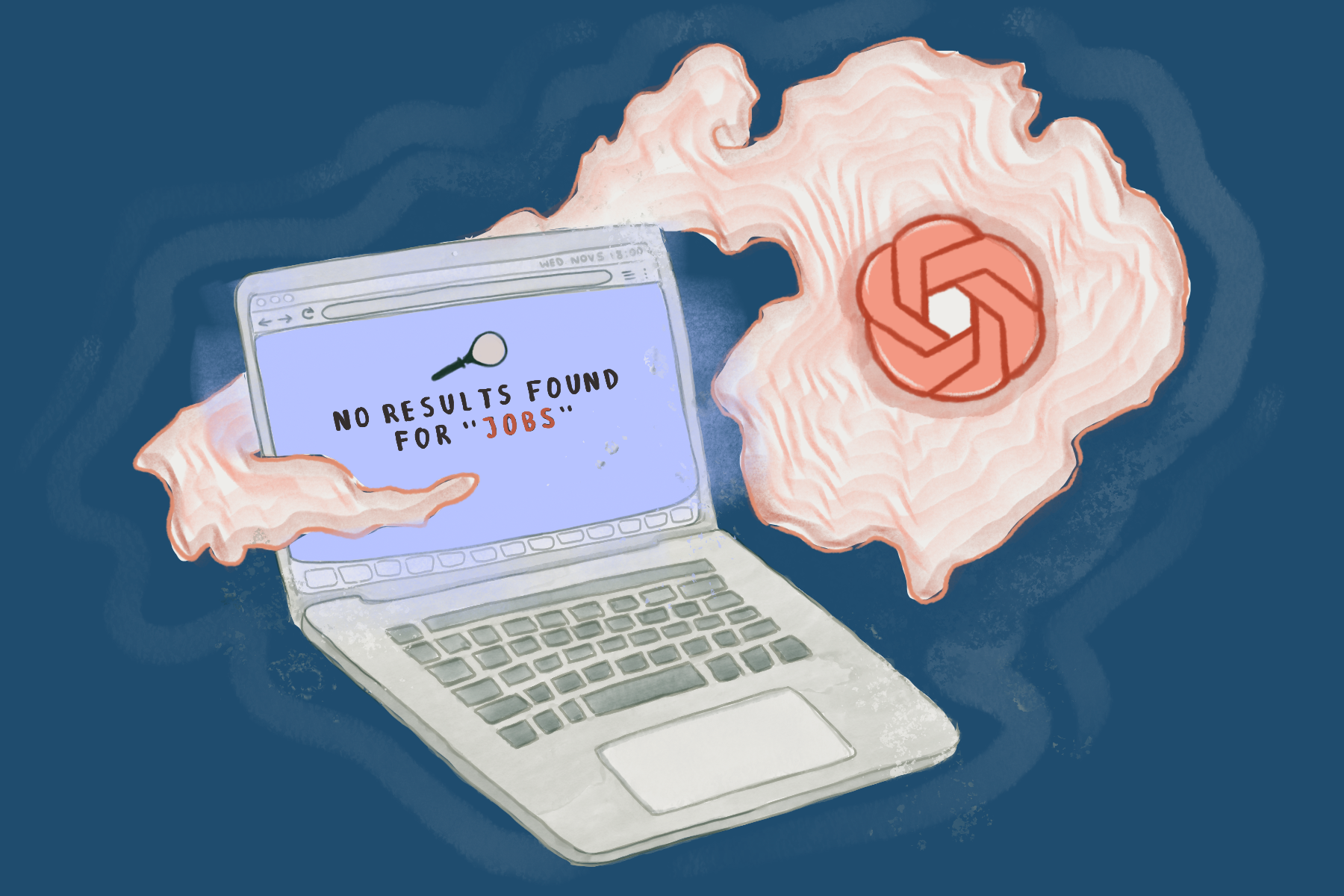
By 2030, 30% of current U.S. jobs are projected to have the potential to be automated, with 60% of career tasks becoming exponentially modified by AI. AI prevalence in the workforce is projected to significantly influence a shift in high-demand occupations. We haven’t graduated just yet, but the question remains: Will you lose your future job to AI? Or because you don’t know how to operate without it? The faster we adapt AI to our average lifestyle, the more we welcome these risks with open arms.