
Spoilers ahead for “Wicked: For Good” (2025).
In endorsing “Wicked: For Good,” I have to add an asterisk. I must concede to a deluge of frustratingly valid complaints—it’s overlong, it’s tonally inconsistent, it has two immersion-breaking deployments of knitwear and, worst of all, its middle 30 minutes are totally unwatchable. Still, I can only describe this moviegoing experience as uneasily brilliant.
The biggest complaint I’ve seen thus far is that the charm and lightness from the first part is lost. It’s true, we’re not at wizard school anymore. Elphaba (Cynthia Erivo) is a vigilante activist on the run, launching disastrously ineffective attacks on the authoritarian Emerald City that straddle the line between revolution and terrorism, while her ex-best friend Glinda (Ariana Grande) is being groomed to be a puppet ruler/Hollywood starlet, constantly forced to confront the price of her success through a mise-en-scène packed to the brim with mirrors and reflective surfaces. The side characters that were humorously prickly in an academic setting now become grotesque; himbo boyfriend Fiyero (Jonathan Bailey) is a police captain who threatens people with extralegal gun violence while brusque headmistress Madame Morrible (Michelle Yeoh) exercises her passion for graphic design through disturbingly racialized caricatures of the Wicked Witch.
Yet this genre confusion somehow deepens the original’s thematic core. The appeal of “Wicked” as a franchise is, and always has been, the cheap delight of “what if the ‘Wizard of Oz’ took place in high school”—a pretty juvenile concept echoed throughout pop culture of the last 30 years (think animated sitcom “Clone High,” “Descendants” or toy franchise “Monster High”). Americans are obsessed with high school, the formative years of adolescence when one’s frontal lobe is irrevocably scarred by inane social dynamics and rudimentary understandings of love, status and happiness. Taylor Swift’s “You Belong With Me” music video is eternal. The term “peaked in high school” is a derision with teeth precisely because it’s so often psychologically true. “Wicked: For Good,” then, radically innovates this template by continuing the story. It’s the movie equivalent of stalking your ex-classmates on Facebook and Instagram and watching all the most intolerable people from high school enter positions of power completely unchanged. Evil gay theater kid minions become evil gay secretaries. Incel loners pining after unattainable crushes become incel politicians pining after unattainable office personnel. The hot popular girl is engaged to her noncommittal high school sweetheart and also becoming a national propaganda symbol. Everyone works in marketing. It’s a frightening prospect, but powerfully resonant.
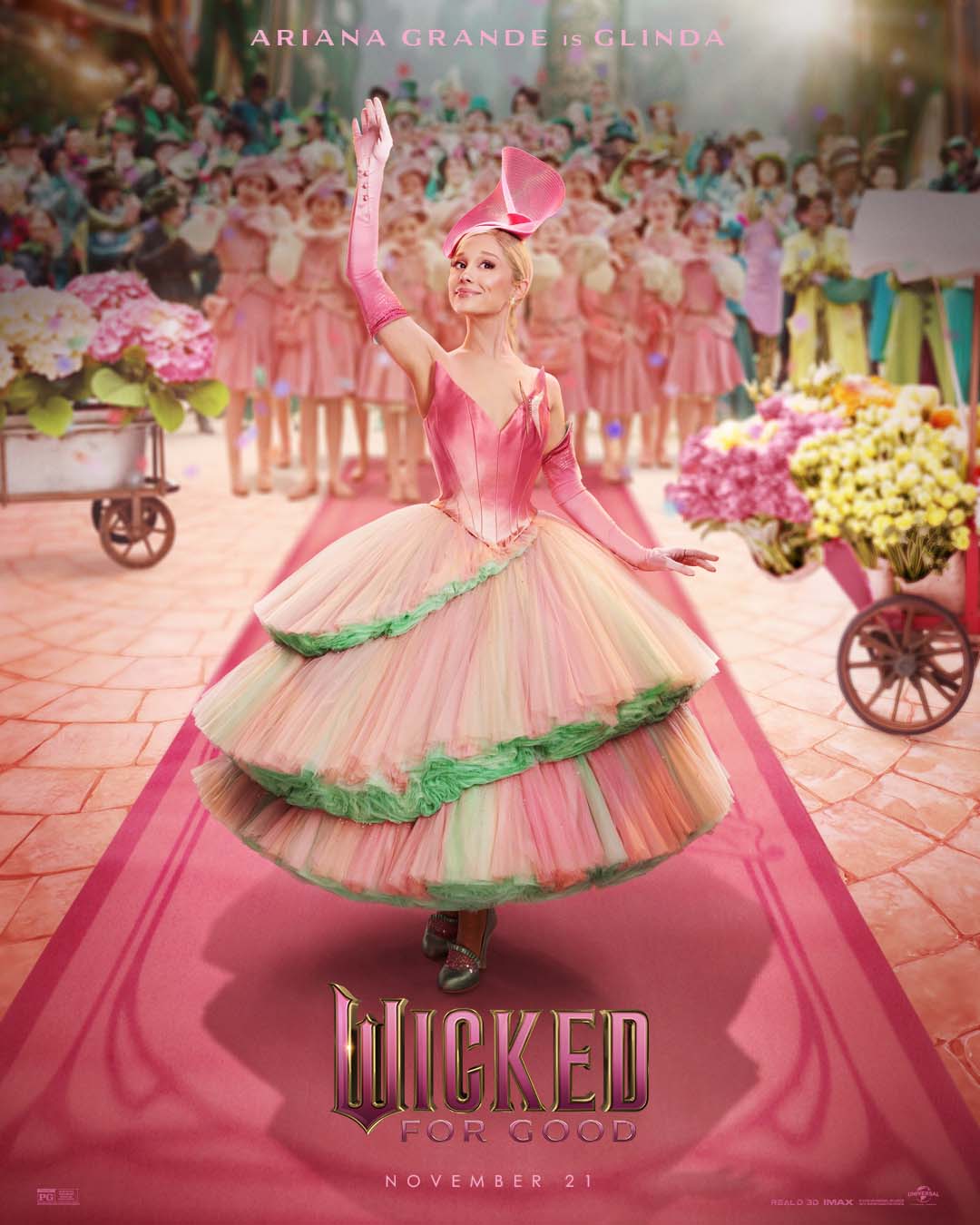
Speaking of Glinda, Ariana Grande is able to outshine a cast that is much improved from the first film. While Cynthia Erivo has an unmatched presence, a dearth of decent musical material means the star of the show is Grande’s face. She conveys a level of anguish and total despair that makes it impossible to not recall the rock-bottom events of her public narrative six years ago, the two most harrowing of which are integrated into one extraordinarily cinematic catastrophe on her wedding day. This movie absolutely works the classic Hollywood close up, painting the enormity and absurdity of the world across the planes of Grande’s tear-streaked face. The way her makeup is caked on and lit suggests, perhaps accidentally, that Grande is constantly wearing a perilously fragile mask. And by the time the finale number rolls around, you get the uncanny feeling that the character of Glinda is sloughing off of her.
All of this is to say that the first half of the film is genuinely exhilarating, a swirling rush of soap-operatic emotions magnified to huge scale, pumping lifeblood into a narrative framework that should not work as well as it does. Romance and tragedy are articulated boldly and sincerely in the way that Hollywood spectacle should, without a hint of irony or self-referentiality. Life and death circle each other like duelists with the ferocity of an ancestral blood feud.
That’s why I have room in my heart to forgive the middle segment for essentially being a sloppily edited-together signpost that says “GO WATCH THE WIZARD OF OZ,” and a transition into “For Good” that’s at best extremely ungraceful. Luckily, it’s the show’s best song and the best musical number across both films. The scene is played completely straight, no frills or jarring intercuts that so often violated the musical crescendos in the first part. To preserve a clever adaption choice, I’ll only say this about the ending sequence: it transforms the pragmatic shadow play of the original musical into a remarkable summation of both “The Wizard of Oz”’s reflexive cinematicness and the puppetry-illusion motif of the stage musical.
I cannot commend this movie enough. I don’t know how it got my dehydrated tear ducts to flow at a scene I didn’t care for when I saw an off-Broadway of “Wicked” at 14 years old. I don’t even think this is the product of one singular vision—it feels more like the product of many very, very, devoted, fanatical and skilled creatives working together to pull an accidental masterpiece out of nearly unsalvageable source material. “I have been changed for good,” indeed.