


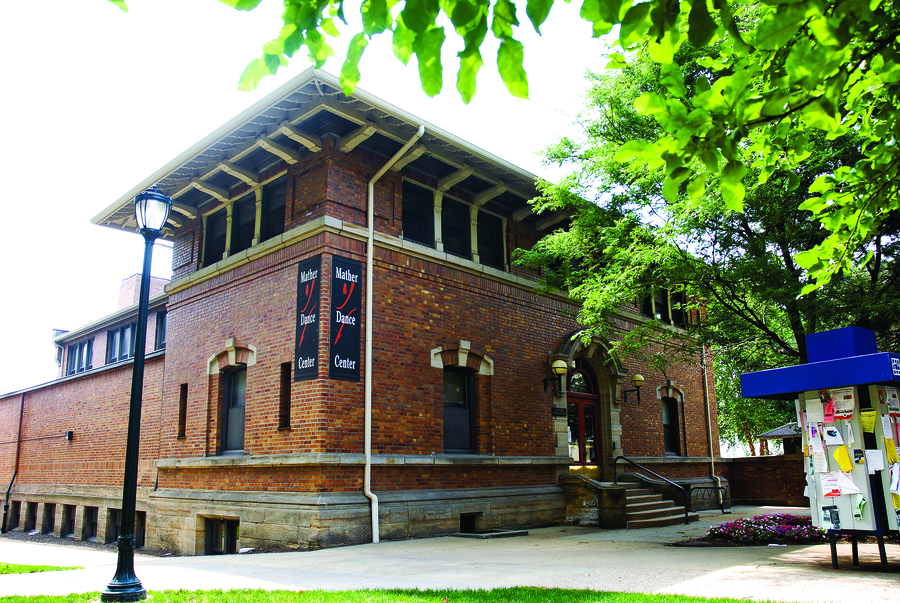
Case Western Reserve University’s Mather Dance Collective (or MaDaCol) had its fall production from Nov. 20 to 22, with tickets sold for $15 starting 30 minutes before the show. The evening featured a compilation of four elaborate 10-minute-long dances, all polished and put together with incredible production quality, lights and music.
The first performance, “Unification,” is somber from the beginning, set to a slow but hopeful piano piece. The dancers portray characters that are weary and struggling, at times on their own but also together, reaching toward the unattainable. Choreographer Ziyue Wei was inspired by the Chinese myth “KuaFu Chase the Sun,” highlighting this theme of unity throughout the piece. The dancers begin alone, struggling by themselves. There’s a certain weariness that fills each one as they labor alone, fight alone, but later find each other. After joining together several times and separating, the dancers join together one last time in a circle, the spotlight highlighting only them until it too fades away.
The second performance, Lucia Mancha’s “I’ve Been Looking For You,” is a lighter piece. The music conveys a happy, energetic mood which ultimately seeps into the spirit of the dance as well. A lot of the choreography focuses on formations in pairs as bonds form between characters in their search for this sense of connection. The groups are fleeting and ever-changing, sometimes separated by lines of dancers until they find each other again. The story ends with connection, where pairs meet for a final embrace. More than anything else, this piece is beautiful and happy, the blue costumes and charming music adding to the spirit of the story.
In the third performance, “Checkmate…?” by Richard Oaxaca, there is a clear story, which made it the most entertaining. There is a battle between both sides of a chess board and the separation is immediately made clear. The piece opens with a king and a queen emerging from each side, standing in front of their loyal subjects. The fight is relentless yet graceful all the same, with small skirmishes across the board between the other pieces, while the opposing king and queen face each other. Then, in the peak of the fight, pieces are killed one by one until black wins. The white king surrenders and peace seems to be approaching—until a traitor reveals (with a gasp from the audience) that they were the white queen all along, killing the black queen.
The final performance was “Awakening,” by Zhaonian Li. It was immediately clear that this piece is much more serious and tense, an effect created by the ticking of a clock that blended with the music the dancers moved to. At some points the clock would stop ticking, the music would turn hopeful and the freed dancers would flow across the stage. However, once the clock began to tick once more, the sense of urgency and struggle returned. The tempo quickens, weighing everyone down more and more until the music stops and the dancers drift away.
The organization of the pieces leading up to the final performance was a matter of hard work throughout the entire semester. Co-Presidents Allison Knop, Rafaella Ortiz Cardenas and Akhila Venkat led this initiative, coordinating the initial reverse auditions, placing dancers, managing funding and costumes and keeping track of progress while communicating with other productions to make sure things were flowing smoothly. “It was honestly my way to connect with the dance community and one of many brilliant communities of dance around campus,” said Knop.
MaDaCol’s uniqueness comes from its connection to the community beyond CWRU. “I think we’re one of the few clubs that have community members be [a] part of [it], like some non-Case students. And I think we’re also one of the oldest clubs [on] the campus because last year it was MaDaCol’s 40th anniversary” said Cardenas. Many dancers have been part of MaDaCol for nearly as long.
When asked about the future, Knop hopes for a greater diversity of dancers: “our club mission is a lot about just promoting different people working together on a dance … encouraging people no matter what dance background they come from.”
The MaDaCol tradition continues next year, with a new set of programming. Stay tuned for reverse auditions beginning in August!