


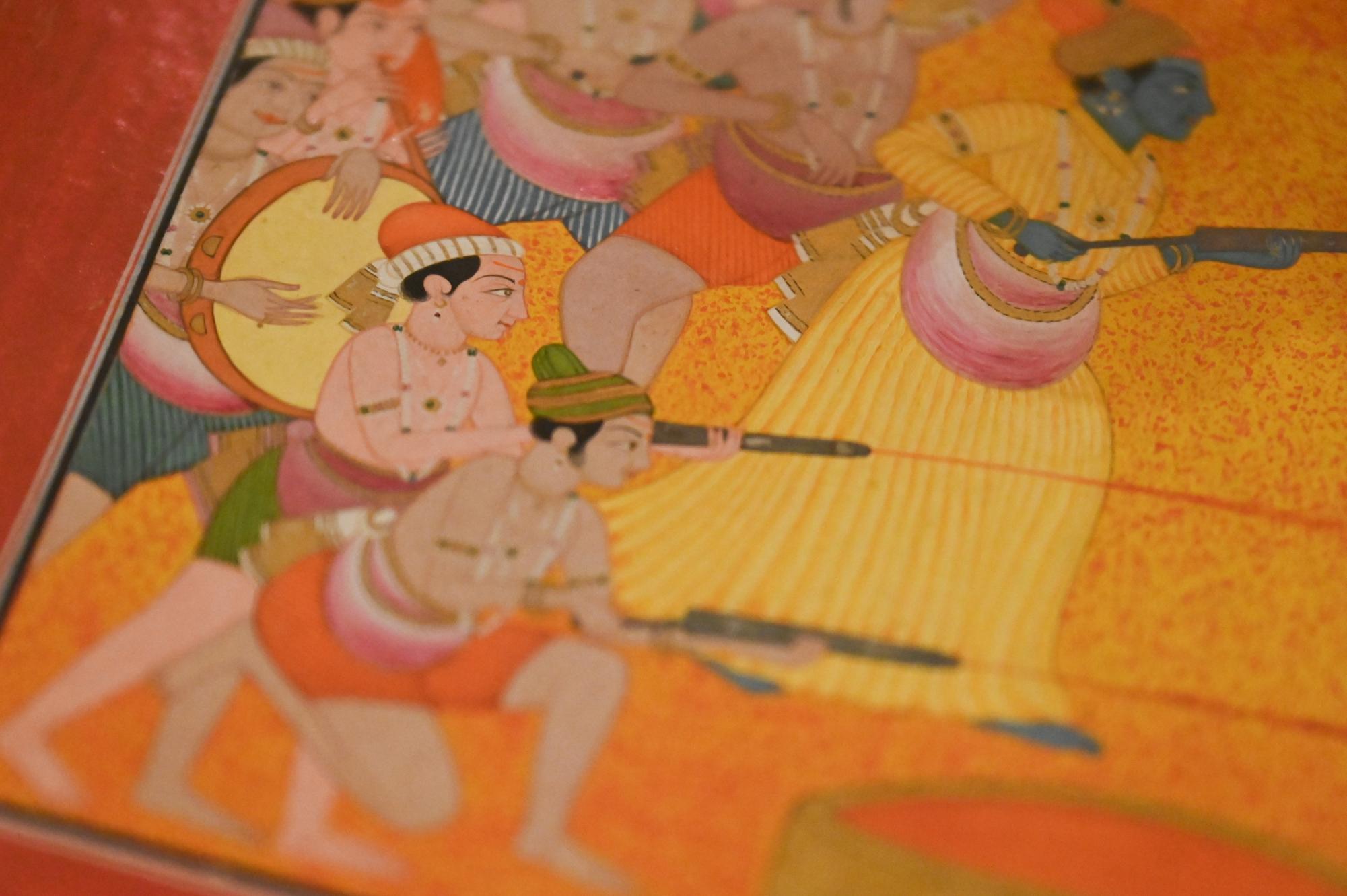
As I stepped into Gallery 242B at the Cleveland Museum of Art, the first thing that caught my attention was how compact the paintings were; some were as small as the brochure in my hand. To see them clearly, you have to lean closer to the glass, but once you do, they demand your attention in a way that many larger paintings don’t.
The exhibit in question, “Pahari Paintings: Art and Stories,” is centered around its namesake: a style of painting created between the 1600s and early 1900s in the Himalayan foothills of Northern India. During this time, the Hindu nobility of the Pahari kingdoms commissioned paintings for their collections—a task handed to artists with a family history of creating art throughout the region. By the late 20th century, descendants of the royal families had dispersed the paintings, increasing their popularity and recognition worldwide. This exhibit “celebrates the CMA’s 2018 acquisition and 2026 publication of the Pahari paintings from the renowned Catherine Glynn Benkaim and Ralph Benkaim Collection.”
Walking through the exhibit, which includes several paintings and textiles from the Pahari kingdoms, one thing that stood out to me was the level of detail present in the pieces. For as small as they are, they are bursting with intricacies that seem impossible for a human to pull off. There is no shortage of vibrant colors to be seen throughout every one of these paintings.
This vibrancy is something that also catches the attention of Dr. Sonya Rhie Mace, the museum’s curator of Southeast Asian art.
“I think it has to be the colors,” Mace said. “These paintings are made with mineral colors … ground from minerals like malachite, cinnabar [and] lapis lazuli.”
She explained that the artists who made Pahari paintings had access to major trade routes due to their location, allowing pigments to travel from place to place. Families mixed their colors in different ways, creating a wide range of color combinations that look striking to this day.
Mace also reminded me that these works were not made to be seen under the bright lights of a museum exhibit.
“You have to imagine them being viewed at nighttime, just under lamplight, in the surroundings of a royal court. The gold and silver and tin would glint and shimmer in the lamplight,” Mace said.
As I moved through the gallery, it became more apparent how central storytelling is to Pahari paintings. Piquing my interest in this regard was the “Madhavanala-Kamakandala” romance. One of the paintings depicting this love story shows a musician named Madhava playing a vina (stringed instrument), leading five women to pause in various moments of reaction—two of them dropping their pots after becoming so entranced by the music. Another painting depicts women in enchanted ecstasy under a tree, their gazes fixed upon Madhava playing his vina as their bodies blissfully lean toward him.
But romance is merely one thread in the gallery’s broader collection of stories. Another painting that drew my attention was “Krishna celebrates Holi.” In contrast to the more subdued intensity of Madhava’s performance, this scene bursts with joyful chaos. Attendants fling bright powders at one another during the festival of Holi, creating an atmosphere that invites you into the scene, making you wish that you could be there amongst the festivalgoers. For how small this painting is, the energy is undeniable; it is not just a depiction of a religious figure, but also an encapsulation of playfulness, celebration and communal joy.
As I was immersed in the delights of these paintings, there was one thing that remained in my mind: Why now? Why did the CMA think that now was the right time to display these paintings? As per Mace, there were several reasons behind this timing. One merely had to do with logistics—the museum’s collections must rotate over time. Another was the publication of a catalog explaining in great detail the history and background of Pahari paintings in the CMA’s collection—a catalog that Dr. Mace noted took several years to write. However, she also pointed to the broader cultural significance of the collection.
“I also think it’s important, in a timely way as well, to draw attention to the culture of this region. It’s a region that stands between Kashmir, Ladakh, China and Tibet [and] Pakistan, … and so I think it’s important to draw attention to the way borders today actually cut across historical and cultural regions,” Mace shared.
For her, the exhibition is not just about displaying beautiful objects but also highlighting a region with a shared artistic heritage that predates modern political boundaries. By presenting these paintings together, the museum is able to restore some of the coherence that has been complicated by history and geography.
Mace concluded by sharing her ultimate hope for visitors going to the exhibit.
“I hope they will see this distinctive vision that the Pahari artists had towards both portraiture and storytelling, to present the world, to present nature, and in a way that that no one else has in the rest of the world…it’s these kinds of human emotions that connect us all…and hopefully people who visit feel that connection.”
By the time I left the gallery, that felt very true to me. The exhibit may be a small one, but the paintings are expansive. Centuries after their creation, they still invite viewers like me to lean closer. Not just to see the details, but to also feel the connection. And it’s a connection that can be felt by all who visit the CMA between now and Sept. 13, the last day of the exhibition. The CMA will also be presenting the related exhibit “Epic of the Northwest Himalayas: Pahari Paintings from the ‘Shangri’ Ramayana” beginning April 19, so be sure to come back in the spring to view that one as well. Don’t miss your chance to experience these paintings up close.