


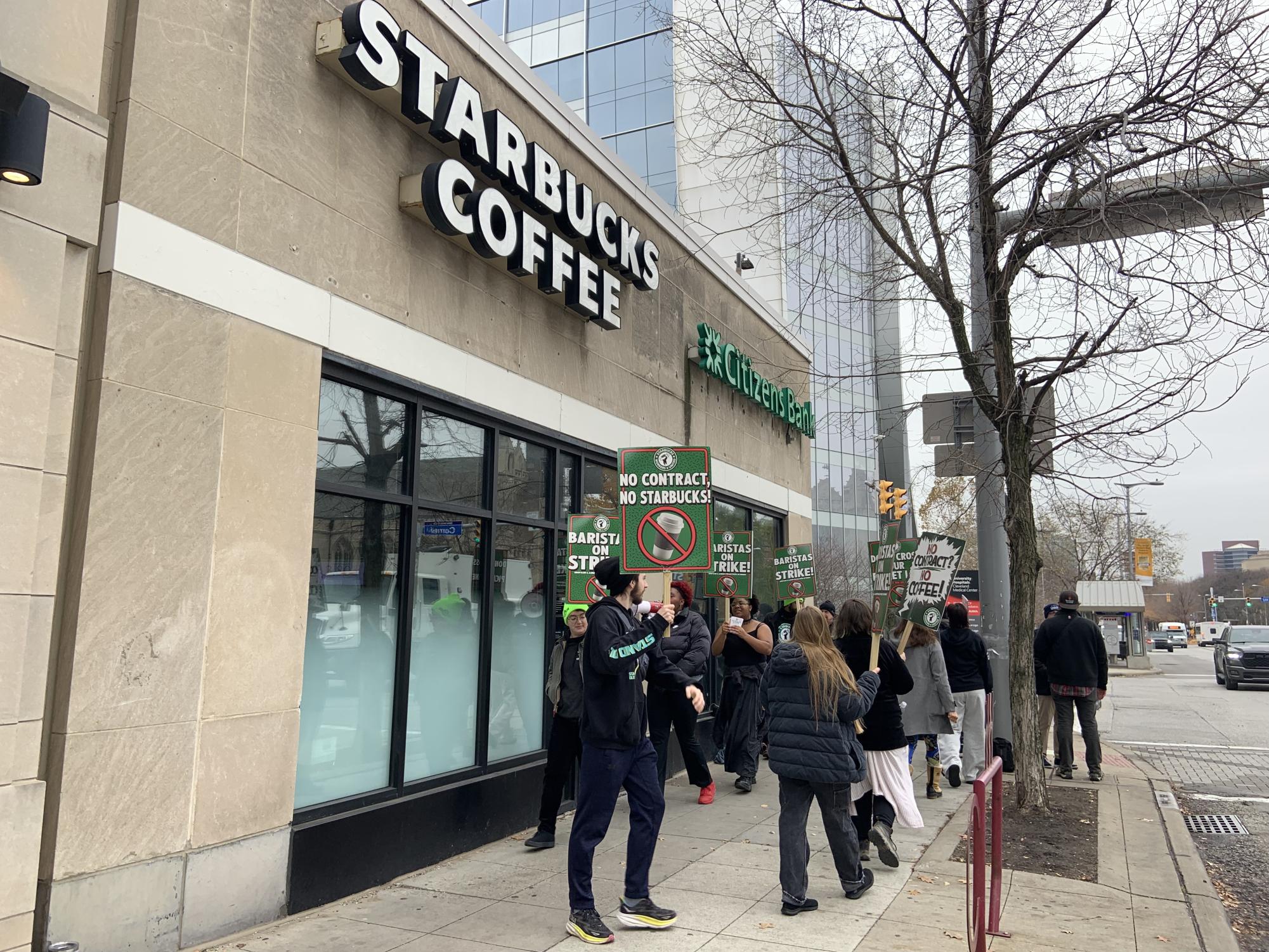
On Nov. 20, employees of the University Circle Starbucks on Euclid Avenue and Cornell Road and their supporters gathered in front of the building, chanting phrases such as “No contract, no coffee” and “No money, no mocha.”
“We unionized our store in July of 2022, and we unionized because we wanted better working conditions, pay, schedules and health care for our workers. And that’s still true,” Akshai Singh, a union barista who has worked at the store for the last four years, said.
The University Circle Starbucks rally echoed nationwide demonstrations organized by Starbucks Workers United (SWU). Dubbed the “Red Cup Rebellion,” the rally was scheduled to coincide with Starbucks’ Red Cup Season campaign, which offers free, limited-edition, reusable red cups with customers’ orders.
“Union baristas are prepared to make this the largest and longest strike in company history during the critical holiday season,” the SWU website states.
Representing about 11,000 employees at around 550 locations nationwide, the union demands “better hours to improve staffing in stores, higher take-home pay and resolution for unfair labor practice charges for union busting.”
The strike kicked off at various locations across 65 cities across the U.S., and by Nov. 28, baristas in 120 stores across 85 cities were involved. However, Starbucks says these numbers are inflated.
“[As of] Dec. 1, only about 55 stores are impacted by the strikes, and 29 of the original striking stores have reopened,” Jaci Anderson, a spokeswoman for Starbucks Corps., said.
To build public support, SWU created the “No Contract, No Coffee” pledge, where customers pledge to boycott Starbucks while the strike is ongoing.
“We’re out here striking for an indefinite [period], [and] we’re the 100th store in the country to file for union and district. So, we’re asking people to skip Starbucks until we get a new contract for our workers,” Singh said.
Despite more than 125,000 pledge signatures, Starbucks reported this year’s “Red Cup Day” garnered the most sales in company history.
At the University Circle Starbucks, responses to the protest were mixed. Cars passing down Euclid Avenue honked their horns in solidarity with the employees. Other onlookers showed less support, weaving between the crowd with a Starbucks cup in hand, and, in one instance, throwing trash out of the window of a moving car.
Still, the union baristas remain committed to the stakes of the strike.
“The only thing that protects people from being fired in at-will employment for any reason is a just cause, and that’s in a union contract most typically, so we have been enduring the most union busting in corporate history,” Singh said.
SWU initiated their nationwide strike after 18 months of bargaining. Starting in April 2024, union and Starbucks executives created 33 potential agreements. Negotiations ended in September, after Starbucks denied additional union proposals to increase wages and benefits.
In response, SWU filed a national unfair labor practice (ULP) charge in December, which was later expanded in April 2025. The union alleges the company adopted new policies, such as a stricter dress code, without discussion. Over the past year, SWU has filed more than 100 additional ULPs in response.
In spite of these setbacks, Singh highlighted the progress made towards the union’s objectives.
“We were able to negotiate 90% of our contract regarding work conditions with the company,” Singh said. “Now we are calling them back to the table for economic proposals, which are our wages, healthcare and scheduling.”
At the time of writing, another rally is set to take place at the University Circle location on Dec. 4.