

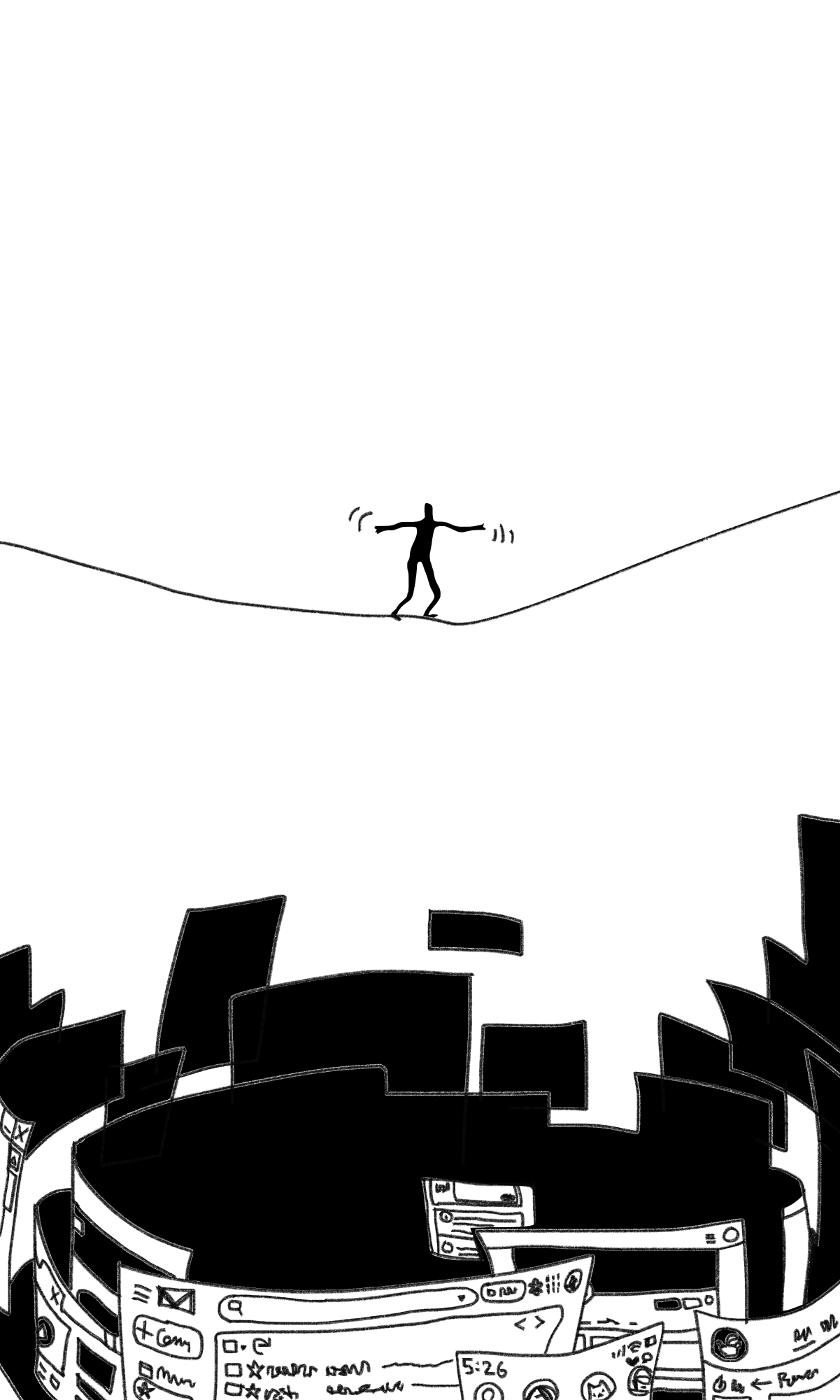
The internet, in theory, is a tool for the democratization of knowledge. And based on functionality alone, it successfully accomplishes that goal—any curious mind through the web can effortlessly find the definition of an obscure word, witness faraway events unfold without taking a single step and compare diametrically opposing perspectives when constrained by the ossified attitudes of one’s own people. The possibilities to augment human cognition that widespread computer ownership foretold led Steve Jobs in 1980 to declare that PCs would become “bicycles for the mind.”
Naturally, the abundance of knowledge carries with it the assumption that ordinary people could assume greater control over their lives and, in turn, create a more democratic society. Those who previously lacked a voice could be heard; information sharing would be dispersed among the public rather than remaining a prerogative of mass media companies.
In reality, most online communities see only 1% of users regularly contribute, and about 90% rarely or never contribute. Factors associated with active engagement include unreliable and heavily-biased sources; vocal minorities with extreme views tend to be the most engaged. Rather than reaching its theoretical possibilities, the internet has hindered vocabulary development, dislocated people from the real world and contributed to the nation’s divide into mutually unintelligible political camps.
Virality on social media platforms hinges on the myriad of often irrational impulses of strangers, who each bear an infinitesimally thin slice of responsibility for the content’s popularity. This collectively means that the scale and speed at which viral content propagates is often enough to counterbalance the fact that most pieces of it serve only to stimulate the impulses for a brief moment. For the individual, the appeal of each successive social media post is usually more than enough to outweigh the ostensibly inconsequential time cost associated with it. Perhaps the reason algorithmically-determined content is so appealing is because it frees people from the burden of conscious decision-making.
That such modes of interaction are characterized by their lack of user agency is not surprising considering that algorithms have become far more sophisticated between the 1998 launch of Google’s revolutionary PageRank and its 2025 introduction of an AI search mode, integrating services like Google Drive, Gmail and Google Docs to hyper-personalize results. Many algorithmic personalization methods, such as TikTok’s “For You” feed which reportedly boosts engagement by up to 60%, now adopt AI. Unlike earlier social networks that facilitated connection, social media platforms’ goal is to keep users online for as long as possible through endless streams of readily-available, often provocative content to profit from selling advertisement data. Paradoxically, websites neutralize users’ agency by inundating them with infinite options.
Choices made from rational calculation give clear indications of purpose. Aimless scrolling, by contrast, represents a perpetual state of indecision where each individual choice neither yields significant benefit nor incurs significant cost. In a way, algorithmic interactions signify an abdication of individual responsibility.
The fact that algorithms influence behavior in some way is not ipso facto cause for alarm. However, they actively promote ideological homogeneity, limit exposure to diverse viewpoints and direct users toward sensationalist narratives by amplifying preexisting biases. A systematic review of a decade’s scholarship on “filter bubbles” revealed that online spaces are fertile grounds for shared memes, vocabularies and humor within groups to the exclusion of other groups; personalized content engenders polarized attitudes even when nothing physically prevents people from seeking alternative sources.
Content that elicits high-arousal emotion, especially out-group animosity, are more likely to be shared online. Viral information on social networks tends to experience a short period of rapid circulation before a steep decline in popularity. Short-form content is the highest performing format online, and while it excels in capturing attention, which research finds usually occurs in the first three seconds after which over 50% of users leave, it tends to spread sentiment rather than fact. And while users may receive the impression of depth or consensus, forms of engagement that occur online are often neither sufficient to sustain long, coherent trains of thought nor provide incentive for further evidence-seeking because responsibility is too diffuse. Combined with the internet’s tendency to spark outrage, which can be amplified by the perceptions of virality engineered using bot accounts masquerading as experts or ordinary citizens, otherwise trivial disputes swell into large-scale online conflicts, wherein each individual user holds little stake.
Although the popularization of the term “doomscrolling” in 2020 and its subsequent addition to the Merriam-Webster dictionary present a bleak view of what the internet has become, the word also reverberates a sharp note of ironic self-awareness absent in a state of total incapacity. Young adults are not unaware of algorithms’ dark designs. Social media has existed for long enough that its principal harms are well-documented in the public sphere, with the Netflix documentary “The Social Dilemma” among other reformist advocacy efforts like the student-led Log Off Movement aiming to develop a healthier human relationship with technology.
These efforts notwithstanding, aggregate usage across platforms has increased since 2021. Algorithms still reward the same short-form, attention-grabbing content as evidenced by the proliferation of mass-produced AI “slop” years later; monetary incentives have not changed even if users have gained awareness. In 2024, 71% of social media images were found to be AI-generated, with 34 million new images generated daily. The idea that people with artistic vision but insufficient resources can materialize their creative talents through generative AI is a tantalizing possibility. But in some sense, a creation’s material form is inextricable from its ideation. Although OpenAI CEO Sam Altman has stated that Sora 2 may bring a creativity “Cambrian explosion,” generative AI often takes imprecise verbal commands and extrapolates images with existing data, producing unpredictable and biased outcomes not explicitly articulated. Without major changes to the internet’s existing architecture, the probable outcome is that vacuous entertainment will continue to be pumped out at even more prodigious quantities. Not unlike social media’s transition into large-scale content machines, AI has the power to accelerate the internet’s transformation into a network centered around commercial output rather than human endeavor.
Popular narratives surrounding digital technology’s harms tend to present the status quo as a toxic place rife with mental illness, fringe views and unending negativity. Such is one face of the internet. “The Social Dilemma,” for instance, paints an almost dystopian image of smartphones controlling humans like marionettes, replete with heavily-dramatized depictions of social media obsession that are no less sensational than the media it aimed to criticize. News stations have accentuated stories of teens killing themselves mere hours after receiving an online threat to emphasize the dangers of technology, although this can motivate legislation that mitigates explicit harms. Independent commentators often describe the internet as a driver of social maladies like loneliness, fragmented attention spans and adverse educational outcomes, perhaps ironically to attract more attention.
Irrespective of the veracity of this fatalistic narrative regarding the collective and longitudinal impacts of the internet, most individual users interact with it in far more mundane, balanced and subtly harmful ways. Even if the web has led many astray with its innumerable negative influences, it has also given others a guiding light with its vast corpus of information. Most individuals, perceiving themselves as less biased, may recognize that their complex motivations to support a cause stem from pragmatism rather than unequivocal belief but are less aware when prosecuting others.
To accept this narrative’s elaborate psychological explanations would be to admit personal fault, which is not necessarily reasonable considering that individual actors who intend to reach a wide audience would be foolish not to use social media. Sweeping measures like school phone bans frame humans’ relationship with technology as adversarial. While the “dystopian” narrative is shock-inducing, it may be ineffective at spurring action. Its underlying assumptions weaken its legitimacy in the eyes of individuals, even those who agree in principle, who can mentally refute them with personal experience or is a member of today’s youth whose important experiences increasingly involve digital media in some form. If algorithms have such severe consequences, then it is others who are cast under their spell.
Thus, the same problem arises when attempting to rectify the internet’s harms as when individuals make decisions about their online activity—a lack of individual agency. Even so, the judgment that social media platforms are devoid of useful or interesting content is indefensible. Plenty of creators make informative, insightful and creative content—and many of them arguably play a more constructive role in attenuating the internet’s toxicity levels than those who leverage generic critiques against the vices of the “digital age.” Online platforms can be educational, entertaining, novel, collaborative, expressive, social and critical to sustaining digital activism. But the internet is also suffused with half-truths and incendiary posts with which the scintilla of wisdom are often interlaced. The internet’s role in shaping the future is unclear as of yet but perhaps it is best to remember that regardless of how skilled algorithms are at manipulating human agency, they ultimately lack the physical means to do so.
Finally … I got through this article … Writing about user agency has nearly made me lose my own self-awareness. And you got through it too … But the real question is, did you do it without getting distracted by your phone?