



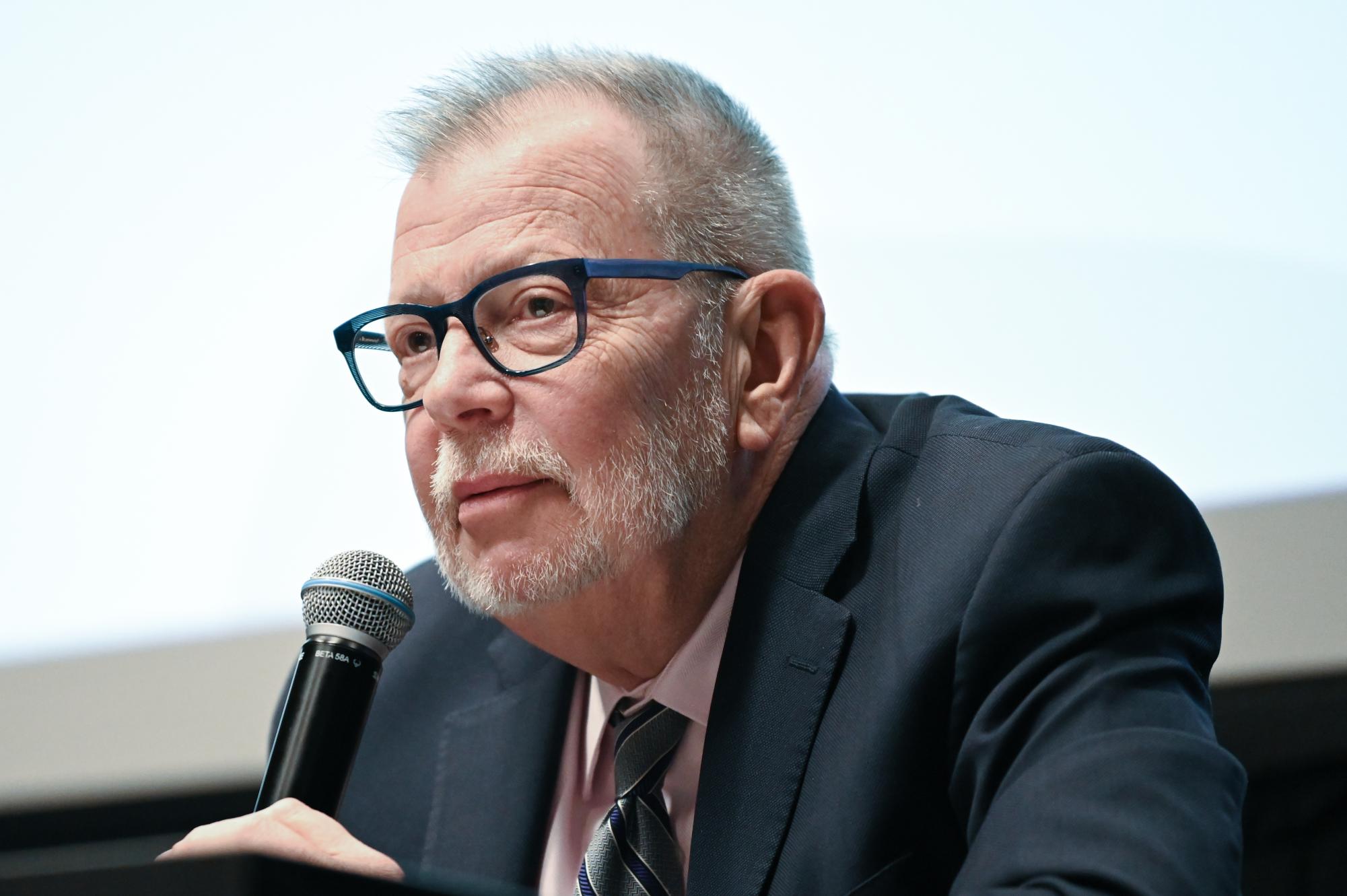
On Nov. 11, the Case Western Reserve University Undergraduate Student Government (USG) hosted their annual Q&A session with President Eric Kaler. Held in Eldred 203, 48 people attended the event. The one-hour session mostly consisted of Kaler answering curated questions USG had collected from the student body and their general assembly, followed by a short open floor Q&A section at the end of the hour.
“The purpose of Kaler’s joining the USG General Assembly meeting is to further foster a connection between USG representatives, the student body, and administrators,” fourth-year USG President Zelene Desire said. “As many people feel a disconnect from President Kaler, this forum is an opportunity to bridge that gap. Usually, these meetings would be an invitation to President Kaler to our regular GA in the Toepfer Room of Adelbert, but last year we expanded to allow more students to be a part of this discussion. Our goal then is to express to him students’ concerns on pressing issues on campus.”
Below is The Observer’s breakdown of the curated question section.
Administrative communication
While Kaler will not hold office hours to meet with community members, he highly encouraged students to email him at president@case.edu or bring concerns to student representatives like Desire.
The university is “working on driving brand awareness” through signage and advertisements, which they expect will improve the university’s notability.
Regarding the university’s ranking, Kaler said that college rankings have “a fair degree of subjectivity,” noting that CWRU is the “second fastest growing research university in the country.”
Due to the tumultuous nature of the current government, the effects of federal and state policy on the university are constantly changing and can sometimes be subtle which makes it “difficult to put [the university’s impacts and response] into formal communications channels.”
Student life
Concerning the custodial changes to upperclassmen on-campus housing, Kaler explained it was to increase efficiency and reduce waste on campus.
Kaler gave updates on the Climate Action Plan that began in 2020, which includes electrifying about 44% of police vehicles, green building certifications as well as laboratory pipette recycling and CLEANR laundry microplastic filters.
Regarding student expression and referring to the Aug. 25 update to CWRU’s Freedom of Expression policy, Kaler said “We’ve made the rules and the procedure more flexible.” “We try to create a structure where demonstration and freedom of speech are allowed, but in ways that don’t disrupt the principal operations of the institution.”
Federal funding
“Overall impact [of federal funding cuts] was really not terrifically difficult for us,” Kaler said. He also noted that undergraduate students would generally not be affected, but it would likely shrink graduate program sizes.
The university senior leadership team is working to lobby for maintaining research funding and making contingency plans should the university face severe funding cuts.
DEI
While federal policy changes have “made it more difficult for institutions to embrace diversity, equity and inclusion,” Kaler said, the university is working to “increase everybody’s engagement and connectivity” and “[maintain] compliance with the federal law.”
Campus safety
Pertaining to concerns about increased U.S. Immigration and Customs Enforcement presence, Kaler said the university would “not cooperate with them unless they have the appropriate legal framework or warrant. We will obey the law, but we will not proactively help.”
Kaler advised students approached by ICE to call CWRU Public Safety or the Office of the General Counsel.
Kaler acknowledged the rise in crime on campus and across Cleveland. He emphasized CWRU’s increase in the police force to “[enable] them to be more appropriately dispersed during peak times.”
AI
Kaler believes AI is an “extraordinarily powerful multiplier of human ability” and hopes students learn to harness AI as a tool for their future careers.
He does note that academic integrity is of the utmost importance, and students should follow their professors’ frameworks and limits on how AI can be used in the classroom.
Financial aid
Kaler addresses the fact that financial aid decreases when students move to off-campus housing, stating that the aid lost is the subsidy for on-campus housing. He also highlights the “competitive rates” of university housing compared to local options.
The university’s financial situation will be evaluated at the end of December where “increasing the lowest paid student wages is on the table.”
There are also plans to aid summer research experiences with “discounted housing, stipends for research [and] a way to make summer tuition more affordable.” Kaler also noted a commitment to helping international students stay on-campus over the summer.
University investments
In regards to student questions about investments in companies implicated in the violence of the war in Gaza, Kaler maintained that the university will not change its stance, due to a “fiducial responsibility to act in its best financial interest.”
“What effect would it have on Israel if we didn’t do that? I think none,” he said. “It’s just frankly impossible to separate funds from certain companies or countries where they have business interests”
The most contentious part of the night was the eight-minute open floor, where individuals raised specific questions and concerns for Kaler.
One of the most novel insights of the night came after a student asked why the Student Advocacy Wall was painted over during Homecoming Week.
In response, Senior Vice President, Chief of Staff and Strategic Advisor to the President Katie Brancato explained that “There was a work order put in to fix the frame around the Advocacy Wall, and someone decided they would just paint the wall. VP Apgar put in some safeguards so that that doesn’t happen again. But it was unfortunate. It was an honest, unfortunate mistake.”
One student shared a mixed opinion about the Q&A.
“I think it’s a very cool experience that President Kaler was willing to come out and take time out of his busy schedule to answer some questions. I think that not a lot of college campuses would do that,” first-year Tristan Holliday said. “I think that I was able to get more information that would otherwise have been difficult to get at the same time. I do think that some of the harder questions were avoided.”