

On Jan. 7, the United States Department of Health and Human Services (HHS) and the U.S Department of Agriculture (USDA) released the 2025-2030 Dietary Guidelines for Americans. Updated every five years, this document details nutrition policies for food manufacturing, food assistance programs and dietary recommendations.
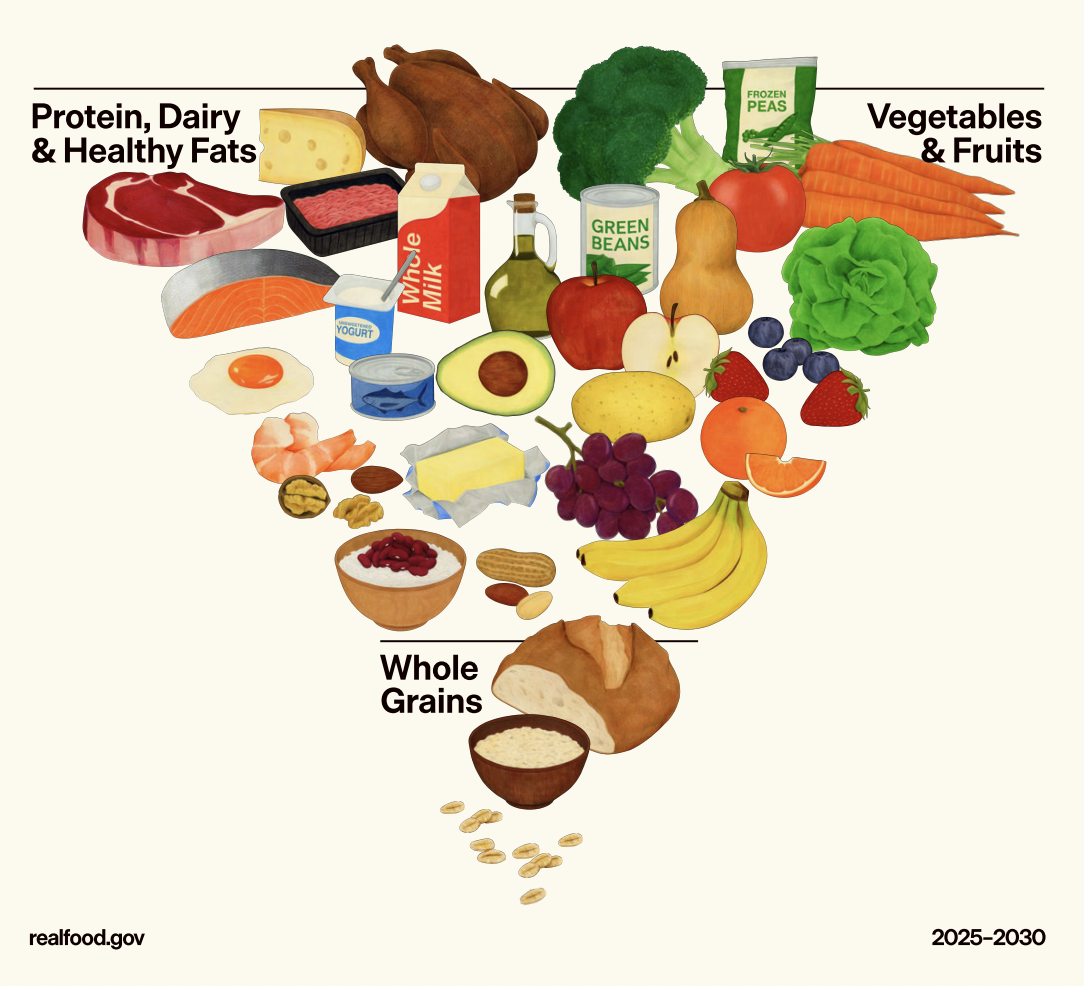
For decades, Americans have looked up to simple visuals to guide what lands on their dinner plates, from the “Basic Seven” food groups in the 1940s to the renowned 1992 Food Guide Pyramid. It emphasized eating more food from the base of the pyramid and less from the top. The Food Guide Pyramid had several versions and was eventually replaced by MyPlate in 2011.Now, one of the latest iterations to the guidelines, the inverted food pyramid, has sparked debates.
The inverted food pyramid prominently features a large cut of steak at its base. According to Dr. Hope Barkoukis, the chair of the Department of Nutrition at the Case Western Reserve University School of Medicine, this design choice could be easily misinterpreted by the consumers.
“The message from that image is [that] it’s perfectly fine to eat as much red meat no matter how fatty it is,” Barkoukis said.
The written dietary guidelines suggest otherwise.
“In the text, [HHS and USDA] stick with [the message of] keep[ing] saturated fats at 10% [of] your total diet,” Barkoukis said. “That message has not changed for many decades. The picture is what’s so confusing because if you sat down and ate that steak, you would be hard-pressed to stay within that 10% guideline.”
Saturated fats are defined by their chemical structure: their carbon bonds are filled or “saturated” with hydrogen atoms. Most of them contribute to cardiovascular disease. Conversely, unsaturated fats contain carbon chains with double bonds and are not completely filled with hydrogen atoms, making them healthier for our bodies and metabolically helpful.
However, it is not that simple.
“More information has shown us that not all saturated fat is equally bad,” Barkoukis said.
That complexity, she noted, is acknowledged in the written guidelines but not in the inverted food pyramid. By placing the steak at the top, the image risks implying a blanket endorsement of red meat. In doing so, it contradicts both the text and the broader nutrition science consensus.
On the flip side, the peak of the inverted food pyramid shows whole grains, visually suggesting that carbohydrates should be consumed in the smallest amount.
“It looks like [the recommendation is to banish] carbohydrates, and that’s not what they are saying,” Barkoukis said. “In the text, the concept of whole grain [is promoted] because the more intact the grain, the healthier it is. It’s going to have dietary fiber, vitamins and minerals.”
The real target, she explained, is not carbohydrates as a category but refined carbohydrates and added sugars, which contribute to calories without nutritional benefits.
The biggest change in the new guidelines is the focus on ultra-processed food as the driving force behind the rising health crisis in America.
“If you look at a label and you see a whole list of ingredients that you have no clue what they are and it’s more than five ingredients, it’s probably an ultra-processed food,” Barkoukis stated.
Ultra-processed food comprises two-thirds of the caloric intake by children and teens in America, according to Friedman School of Nutrition Science & Policy at Tufts University. Barkoukis believes that the heavy focus on shifting away from ultra-processed food would move the needle towards a healthier lifestyle.
In an event with the National Cattlemen’s Beef Association, HHS Secretary Robert F. Kennedy Jr. stated that the “war on protein is over.” These words also appear on realfood.gov, the official website for 2025-2030 Dietary Guidelines for Americans.
Barkoukis believes this remark applies specifically to animal protein and may reflect a reaction to previous federal guidelines.
“Historically, there’s [been] a very heavy push towards plant protein because it’s so healthy for you,” Barkoukis said. “When you eat a plant protein, the package that it’s with is so healthy. It has dietary fiber. Fiber helps you [have] a healthy gut. It has vitamins, it has minerals [and is very] low in saturated fat.”
That emphasis may have led to the relative exclusion of animal protein in past guidelines.
Animal protein is often unfairly stigmatized, Barkoukis explained, as health concerns typically focus on processed meats but are frequently generalized to all animal products.
“Animal protein is healthy but it’s packaged differently,” Barkoukis said. “Their whole point [was to] end the war on animal protein and emphasize a wide variety of both animal and plant [protein].”
The new dietary guidelines have increased the protein recommendations from 0.8 grams per kilogram to 1.2-1.6 grams per kilogram, a range still considered within normal limits.
The rationale behind this change took into account that many Americans are on low-calorie diets.
“[The HHS and USDA] review team looked at hundreds of studies that were done, and the data showed that when one would consume animal protein at the amounts they recommended, [the participants] had better success with weight management,” Barkoukis noted. “They lost less body muscle and were able to have better outcomes.”
Barkoukis said that while these findings are supported by nutrition science, most Americans already consume enough protein, and the real concern is ensuring adequate intake among older adults rather than the general population.
However, the larger challenge lies in how the guidelines are presented. While the core written recommendations remain mostly consistent with previous guidelines and are supported by nutrition science, the disconnect between the text and inverted food pyramid is jarring. The result, Barkoukis believes, is confusion among the public.
“When you do nutrition messaging you [have to] keep it simple [and] you also have to get the person to understand that their whole dietary pattern matters,” Barkoukis said. “[The HHS] is now pushing to have nutrition in the curriculum of medical schools, [and at CWRU, we are teaching them] if they have two minutes with the patients, it’s not to tell them what they can’t eat, it’s to tell them what they can eat.”