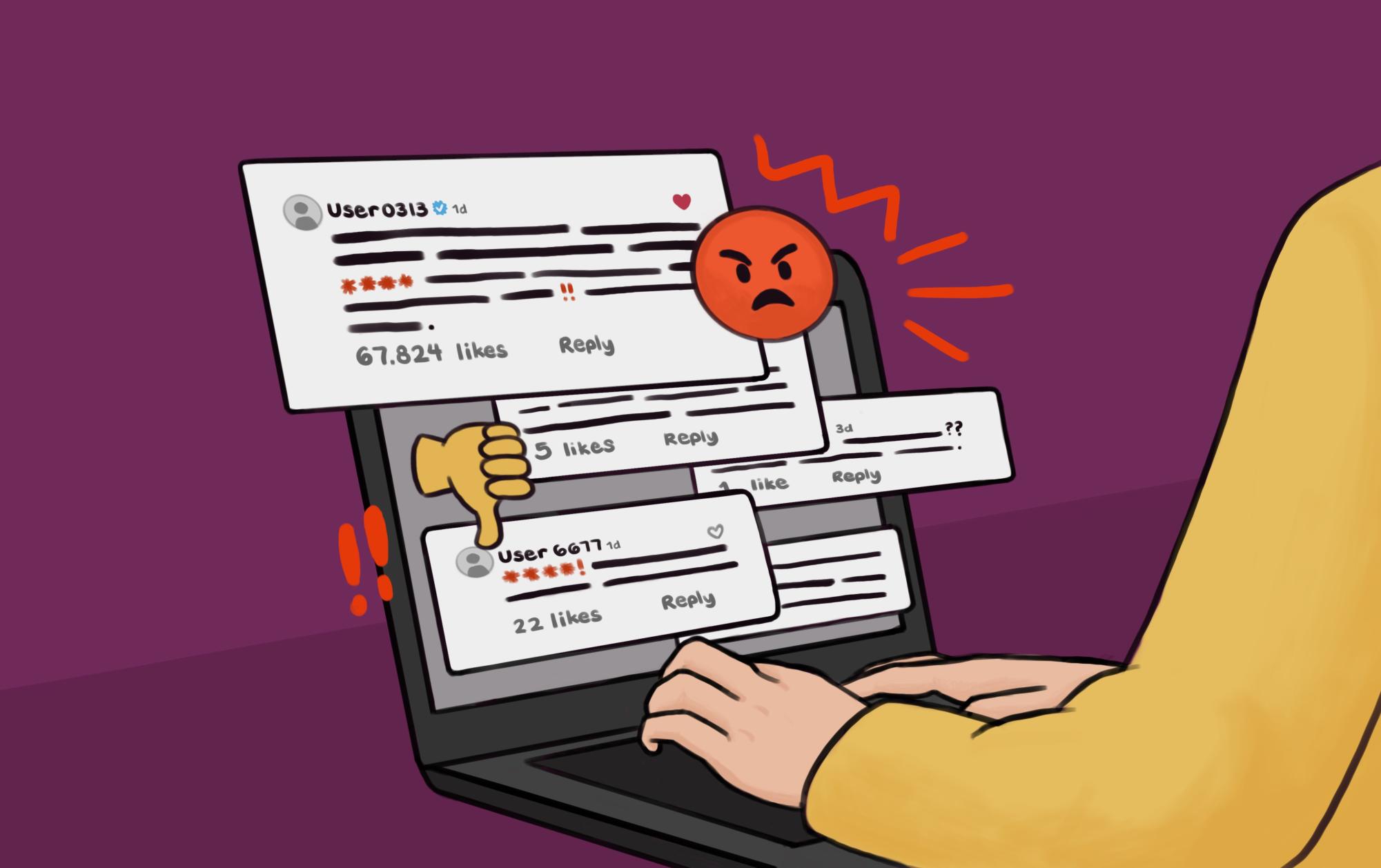


I am partly ashamed to admit that my major news source is Instagram. Although it makes news very accessible, far too often do I open the comment section to arguing blurbs of text, attacks on character and seemingly endless profanity. It could be anything, yet there will still be hundreds to thousands of comments fighting below, engagement which, unfortunately, only gets promoted by the algorithm.
Comment sections can be interpreted as an internet-era letter to the editor (LTTE), a longstanding news tradition that allows readers to publicly react to topical issues and events. Ostensibly, comment sections may seem even more democratic than LTTEs, given that commenters don’t require stationery, postage or passing editorial review. With only internet access and with very minimal regulation or proofreading, commenters are free to say almost whatever they want, good or bad. Yes, there is more freedom to express opinions, but it isn’t constructed in a productive way that can facilitate more thoughtful, comprehensive opinions.
One major problem with comment sections and the internet overall is the prevalence of anonymity. Unlike LTTEs, which can be rejected by editorial review if there are no names attached, comments are designed to be anonymous. Without any repercussions and an identity completely unknown, there are no consequences to be had. As seen clearly in the abundance of more profane comments, this lack of social regulation creates an environment where civility, a core tenet of any debate, is neither required nor regulated.
Despite anonymity, commenter groups still form between respondents with similar opinions. With these groups come social group norms, creating groupthink, which only further harm the aim of democratic discussion in which individuals are represented. Social science finds that, when exposed to groups, people are more likely to conform and adopt the opinion of the more dominant-appearing group. In the case of comment wars, then, that means that the “most-liked” opinion will continue to sway more people and generate influence, even in the presence of other dissenting opinions, preventing respectful interactions between them.
Perhaps the most insidious cause of these problems is the algorithm that boosts any and all engagement. It is well-known among content creators that unusual or controversial content serves as “engagement bait” that attracts viewership and engagement, subsequently causing the algorithm to further promote the content and generate the creator more revenue as a result. Algorithms work almost the same in comment sections. Comments that receive the most replies or “likes” are calculated by the algorithm to be more “popular” and moved to the top, becoming the most visible part of the section. This system promotes high quantities of more engagement-inducing replies, often short and emotionally charged, making popular opinions even more dominant.
Knowing these problems, then, how do we fix them? Moderated comment sections are already very common across websites and can solve the problem of uncivil comments through simple censorship. On a platform like Instagram, however, this increased degree of moderation seems unlikely, and, if China is any example, people are rather skilled at circumventing censorship.
Another suggestion is to have the original posters respond to comments, humanizing the content. This may be more successful when it is an individual posting the content, but for official accounts, which have no personal name or face, the problem of anonymity persists and there may not be the social regulation to support civility. Both these proposals, too, do not solve the problem of group dynamics and influence.
Most importantly, we must create an internet economy that doesn’t rely on constant argumentative back and forths and negative engagement. If social media is considered an entertainment source, then perhaps positive engagement and entertaining content should be algorithmically encouraged over controversial material. Of course, this also means that any debate, even functional, deliberative ones, could lose access to the public eye as well. There’s no winning, is there?
Maybe this is just a sign that important informational news should be kept out of the realm of social media entertainment. Regardless, if the internet doesn’t change, then I encourage you to at least be aware. Know that, under the veil of anonymity, there is a person behind every comment and post (at least, for now) and dissent behind every seemingly unanimous opinion.